The Future ofBusiness Communication
Autonomous AI agents that handle phone calls with human-like natural language understanding. 5 specialized agent types, powered by the world's leading LLMs.
A conversation, not a recording
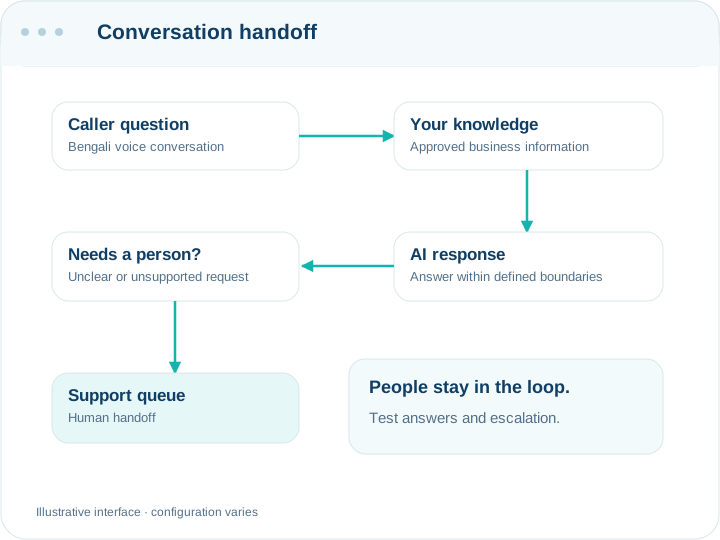
The agent answers in Bangla, works from your own knowledge base, and hands over to a person the moment it should.


What the agent can and cannot do
An AI voice agent answers the phone, understands what was said, decides what to do, and says something back — in Bangla, without a script tree. It is genuinely useful for a narrow band of calls and genuinely unsuitable for others, and knowing which is which is the difference between a feature and a complaint.
The loop, and why latency is the whole game
Speech becomes text, the text goes to a language model together with whatever it can find in your knowledge base, and the reply is spoken back. Each hop costs time, and a caller notices a pause long before they notice a clumsy sentence. The pipeline is tuned around that: the model is chosen per deployment, and the prompt is kept short deliberately, because a two-sentence answer arrives while a five-sentence one is still being generated.
It answers from your documents, not from the internet
Upload your policies, price list, delivery windows or FAQs and the agent retrieves the relevant passage before answering. Ask it something the documents do not cover and the right behaviour is to say so and pass the call to a person — which is what the system prompt instructs, and what you should test before going live.
Bangla is first-class, not translated
Two Bangladeshi Bengali voices ship with the platform, alongside Indian Bengali and English. The agent understands Bangla speech, reasons in it and answers in it. Callers do not have to switch language to be understood, which for most Bangladeshi customer bases is the difference between a system people use and one they hang up on.
Five types, because the jobs are different
Inbound answers your published number. Outbound calls a list. IVR sits behind a keypad menu. Support and Sales carry different instructions and hand over to different queues. They share the same engine and differ in what they are told to do and who they escalate to.
Bring your own provider
The platform has adapters for OpenAI, Anthropic, Google, Azure, Deepgram and ElevenLabs across speech recognition, language models and speech synthesis. Which are configured is a deployment decision, so you can move to a different model or voice vendor without changing how your agents are built.
5 Specialized Agent Types
Each agent is purpose-built for a specific role — from customer support to sales qualification.
Inbound Agent
Answer customer calls 24/7, route inquiries, provide information, and resolve issues without human intervention.
Outbound Agent
Proactive outreach for appointment reminders, customer surveys, payment follow-ups, and promotional campaigns.
IVR Agent
Replace rigid DTMF menus with natural conversation. Customers simply say what they need instead of pressing buttons.
Support Agent
Technical troubleshooting and FAQ handling powered by your knowledge base. Resolves issues step-by-step.
Sales Agent
Lead qualification, product information, appointment booking, and closing — all via natural voice conversation.
How Voice AI Works
Sub-second latency. Natural conversation flow. No awkward pauses.
Pluggable AI Ecosystem
Choose the best AI providers for your needs. Switch anytime without code changes.
Built-in Intelligence
Every call is analyzed, transcribed, and enriched automatically.
Call Transcription
Real-time and post-call transcription with speaker identification
Sentiment Analysis
Automatic mood detection: Positive, Negative, Neutral, Mixed
Language Detection
Auto-detect customer language and respond accordingly
AI Summary
Automatic call summaries with key points and action items
Knowledge Base (RAG)
Upload PDFs, docs, URLs — AI learns from your data via pgvector
Speaker Diarization
Identify who said what in multi-party conversations
The questions worth asking
Will callers know it is not a person?
Most will, and you should assume so. Synthetic Bangla is good enough to be pleasant and clear, not good enough to be mistaken for a colleague. Agents that say what they are at the start get better outcomes than ones that pretend.
What happens when it does not know the answer?
It should say so and transfer. That behaviour comes from the system prompt, so it is worth reading and testing rather than assuming — an agent instructed to be helpful without being told its limits will guess, and a confident wrong answer on the phone is worse than a transfer.
Can it take an order or change an address?
It can collect the information and hand it on. Deliberately, it does not write to your systems by itself: actions with consequences go to a person or through the API with your own confirmation step.
What does it cost to run?
The AI provider bills per minute of speech and per token of reasoning, so cost tracks conversation length. A ninety-second tracking enquiry is inexpensive; an open-ended complaint call is not. Start with the calls that are short, repetitive and high-volume.
How long until it is working?
An agent answering a number with a greeting and a knowledge base takes an afternoon. Getting the escalation rules right — which calls it should never handle — takes longer and matters more.
Ready to Deploy AI Voice Agents?
Start handling customer calls autonomously. Reduce wait times, improve satisfaction, and scale without hiring.